
The decision this guide helps you make
Rules-based automation follows explicit conditions; AI assistance can interpret variable inputs but needs evaluation and review. Choose by the task’s uncertainty, consequences and recovery needs rather than by which label sounds newer.
Compare predictable rules with uncertain outputs, review effort, data boundaries and recovery when choosing how to automate a business process.
Compare the alternatives on authorised examples, error handling and staff effort. Keep consequential actions behind validated operations and appropriate approval.
A practical example to test the choice
Required fields in a fixed form can use ordinary validation. Classifying a free-text enquiry may benefit from an evaluated model, with uncertain categories reviewed by staff.
This is an illustrative planning scenario, not a claim about a completed client project. Use your own records and operating rules to confirm whether the approach fits.
Start with the decision, not the technology label
Describe the task’s input, required output and the conditions that determine a correct result. Some tasks follow explicit rules, such as routing an approved request to a named team. Others involve ambiguous text, classification or judgement. Those differences matter more than whether a supplier calls the product intelligent.
Consider simplification and ordinary integration before choosing a model-based step. If the task is unreliable because records are incomplete or nobody owns an approval, AI does not remove that uncertainty. Define a process that the business can explain and maintain.
Apply the decision to your UAE operation
Write down the actual users, approval limits, record owners and branch responsibilities. A UAE wholesaler, service team and retailer can all ask for a dashboard while needing different information beneath it. Start with representative records and a complete task rather than a module list.
Confirm currencies, languages, permissions and the systems that must connect. Assess English and Arabic fields where required, and document who approves the wording and reviews each interface. Hosting, access and personal-data handling need an agreed model before real customer information is used in a prototype.
Compare the cost of being wrong
For a proposed AI step, identify unacceptable outputs and the person who reviews uncertain cases. Distinguish assistance, such as suggesting a category, from actions that change a customer or financial record. An output appearing plausible is not the same as the task being completed correctly.
NIST’s AI Risk Management Framework provides a voluntary framework for considering AI risks. A project still needs a task-specific assessment: what information is used, who may access the result and which failures require intervention. A framework reference is not certification of the proposed system.
Evaluate the whole workflow in a controlled pilot
Use representative examples and keep a record of the expected decision. Compare manual work, a rules-based option and any proposed AI assistance where feasible. Include exception handling, reviewer time and corrections when assessing value rather than reporting only the speed of the automated step.
Agree a way to pause the workflow and recover from mistakes. Review ongoing provider costs, model or configuration changes and responsibility for checking output quality. Expand only when the evidence supports the next scope, not simply because the demonstration processed a few carefully selected examples.
Use an evaluation set with recorded decisions
Collect representative, appropriately handled examples of the task and have the responsible people identify the expected outcomes. Include ambiguous and incomplete cases rather than only easy inputs. For each proposed route, record the final decision, review required and correction effort. Define which mistakes block wider use. Keep the evaluation set controlled and review its relevance when the process changes. The purpose is to assess the complete workflow, not to produce a headline accuracy figure from a few convenient examples.
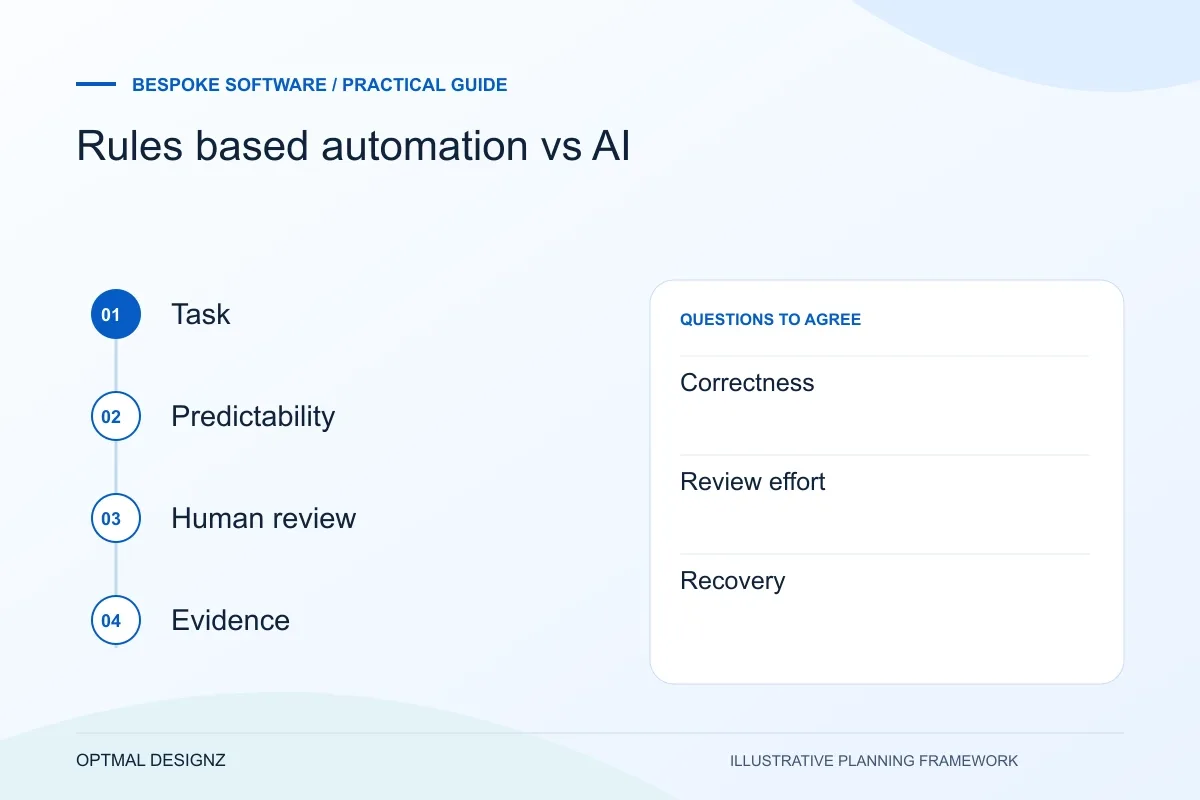
| Evaluation area | Question to answer |
|---|---|
| Correctness | Did the final business decision meet the agreed rule? |
| Review effort | How much human checking and correction remained? |
| Recovery | Can the team stop and resolve an unsuitable result? |
Worked example: a planning exercise
Hypothetical example: an operations team wants to classify incoming requests. Clear categories with explicit keywords can be routed by rules, while ambiguous messages may be suggested for human review. The pilot measures the final correct assignment and reviewer effort. It does not allow uncertain suggestions to trigger irreversible changes to customer records.
Your practical checklist
Use these checks to turn the discussion into decisions that can be assigned, tested and reviewed.
- Define the task, expected output and normal exceptions.
- Identify whether the decision follows explicit rules.
- Assess consequences of incorrect and uncertain outputs.
- Agree data boundaries and human-review responsibilities.
- Compare representative examples including review and correction effort.
- Plan pause, recovery, monitoring and provider-change reviews.
Compare the task before choosing AI
These illustrative examples compare implementation choices; they are not client results or claims of guaranteed accuracy. Choose the smallest mechanism that can complete the task with acceptable review and recovery.
| Task | Starting approach | Acceptance check |
|---|---|---|
| Check required fields in a fixed form | Explicit validation rules | Reject missing or invalid values consistently |
| Classify enquiries written in varied language | Evaluate AI-assisted classification | Compare authorised examples with expected categories and review uncertain cases |
| Find a current internal procedure | Permission-aware search or retrieval | Show the right source version and refuse restricted information |
| Change a customer order | A validated operation with authorised approval | Check access, the exact change and the result confirmed by the source system |
Apply the checklist to your UAE project
For a UAE software brief, distinguish company-wide records from branch or legal-entity records. Define who can approve a request across locations, which regional platform editions are used and what English/Arabic tasks require testing.
Use the example above to discuss rules based automation vs ai with the people who will use or approve the result. Ask a supplier to demonstrate the expected output, explain a failure case and identify what is excluded from the proposal.
Related services and next steps
Sources and further reading
Check source guidance directly, especially where platform details or requirements can change.