
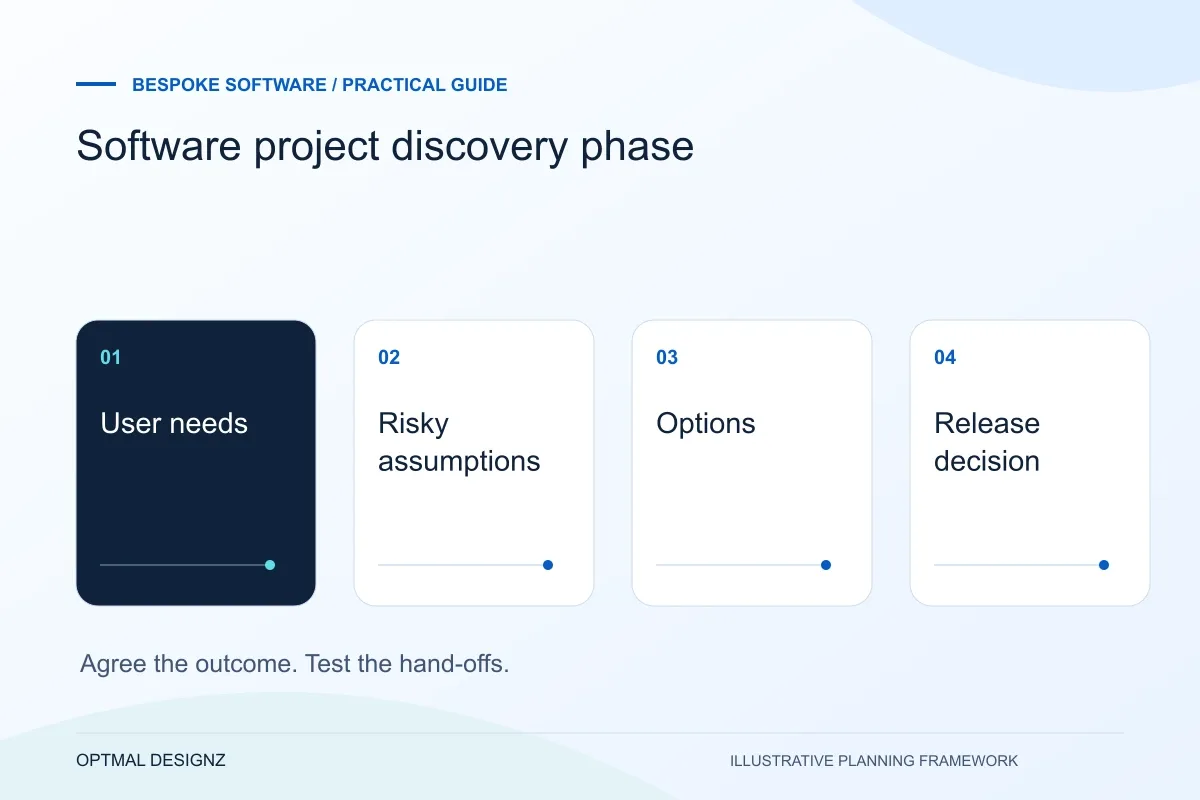
The decision this guide helps you make
Software discovery turns an operational problem into an assessable first-release scope. It examines users, current tasks, records, constraints and alternatives before the team commits to a detailed build estimate.
Discovery is a structured way to reduce uncertainty before committing to a delivery scope. It should produce useful decisions, not a report for its own sake.
Agree concrete discovery outputs: workflow map, important requirements, technical unknowns, priorities and acceptance examples. A workshop alone is not a completed scope.
A practical example to test the choice
A team asks for a new ERP, but discovery may show that one approval workflow and a supported accounting connection address the immediate issue. The output should explain that choice.
This is an illustrative planning scenario, not a claim about a completed client project. Use your own records and operating rules to confirm whether the approach fits.
Begin with users and outcomes
A discovery phase starts by understanding what the organisation is trying to improve and who experiences the current process. The team gathers context from stakeholders and users, reviews the tools already in place and identifies constraints that could shape the project.
The outcome should be expressed in practical terms. Instead of “modernise the system”, describe a task to make easier, information to make more reliable or hand-off to make clearer. A measurable outcome can still be qualitative when a numeric baseline is unavailable; the important part is agreeing how success will be judged.
Turn the checklist into a UAE project brief
Bring the people who use the process into the discussion: branch managers, administration, sales, finance or customer support as appropriate. Record the current difficulty, a sample task and the evidence that would show an improvement. Keep desired capabilities separate from promises made before discovery.
Agree the working language, review timetable, relevant currencies and the responsibility for approving requirements. Delivery is scoped for the engagement; a country-targeted page is not evidence of a local office, an on-site team or an automatic support commitment. Compare proposals using the same acceptance tasks and handover requirements.
Map the current workflow and options
Process maps and user journeys expose steps, decisions, exceptions and responsibilities. They can show where data is entered twice, where approval is delayed or where a spreadsheet acts as an informal system. Treat these findings as observations to validate, not automatic evidence that new software is required.
Compare possible responses: improve an existing product, configure a platform, connect systems or build a tailored application. Include the operating costs, vendor constraints, migration effort and support ownership in the comparison. The best option may involve more than one approach.
- Users, stakeholders and accessibility needs
- Current tools, records and integrations
- Core journeys and important exceptions
- Risks, dependencies and unknowns
- Options, priorities and first-release scope
- Acceptance criteria and a delivery plan
Turn findings into a decision-ready scope
Discovery should result in decisions the organisation can use: which problem to address first, what is in or out of scope, what assumptions remain, and what delivery path is recommended. Depending on the project, outputs may include wireframes, process diagrams, a technical outline, migration questions, a risk list or a phased estimate.
A useful scope is specific enough to estimate and test, but flexible enough to respond when new evidence appears. The team should explain which parts have the most uncertainty and what information would reduce it.
Ask what the discovery work will produce
Before starting, agree who will take part, what information is needed, how long the discovery is expected to take and what decisions it should support. Ask how outputs will be shared and whether they can be used to compare delivery options or suppliers.
Discovery does not guarantee that a project should proceed. It is valuable when it gives the business a clearer basis to build, configure, integrate, phase or stop.
End discovery with decisions and open questions
A useful discovery output separates confirmed requirements from assumptions, risks and questions requiring supplier access or specialist review. Give each open item an owner and a way to resolve it. Identify what the first production outcome could be and what still needs a prototype. This prevents a discovery document from becoming an unqualified promise that every proposed feature is ready to estimate.
Apply the checklist to your UAE project
For a UAE software brief, distinguish company-wide records from branch or legal-entity records. Define who can approve a request across locations, which regional platform editions are used and what English/Arabic tasks require testing.
Use the example above to discuss software project discovery phase with the people who will use or approve the result. Ask a supplier to demonstrate the expected output, explain a failure case and identify what is excluded from the proposal.
Related services and next steps
Sources and further reading
Check source guidance directly, especially where platform details or requirements can change.