
The decision this guide helps you make
A content management system lets authorised staff update website content without editing application code. Choose it by testing the publishing tasks your team actually performs, including approvals, previews, images, reusable pages and user access.
Compare content editing, approvals, publishing, access and maintenance before choosing the CMS behind your business website.
Prefer a configured CMS when normal publishing needs are covered. Consider custom editing only where content structure, access or workflow cannot be supported sensibly by the existing platform.
A practical example to test the choice
Ask an editor to add a service page, replace an image and correct a published article in the proposed CMS. A polished supplier demo is less useful than watching your own task from draft to publication.
This is an illustrative planning scenario, not a claim about a completed client project. Use your own records and operating rules to confirm whether the approach fits.
Start with the people maintaining the content
A content management system should fit the work your editors need to do. List who creates, reviews and publishes information, how often pages change and whether different teams own different sections. A business updating one service page each quarter has different needs from a team publishing daily product or recruitment information.
Ask an editor to perform a realistic task during the evaluation. Replace an image, change a heading, add a related link and preview the result on a narrow screen. Notice where technical help is required and whether the editor can tell which changes are still unpublished.
Turn the guide into an Oman website brief
For an Oman business, start with the audience and the action the website needs to support. A service enquiry, trade catalogue and consumer checkout need different page structures and information. Use genuine service coverage for Muscat, Sohar, Salalah and other relevant locations instead of creating interchangeable city pages.
If the audience needs English and Arabic, assign content ownership for both languages. Agree right-to-left layouts, paired pages, form messages and how changes will be maintained. Where online sales are involved, confirm OMR formatting, delivery coverage and the capabilities of the actual merchant and logistics accounts.
Test content structures rather than a blank editor
Identify repeatable types such as services, staff profiles, locations or case studies. Structured fields can help keep those pages consistent, but the structure needs to match the actual information. Too many rigid fields can make a small change unnecessarily difficult; unrestricted layout tools can introduce inconsistent pages.
Review roles and approval requirements separately. WordPress documents roles and capabilities that govern editing and publishing, but your proposed configuration still needs testing. Do not assume that a product label or a default administrator account provides the appropriate boundaries for your team.
Include the platform after launch
Compare account access, backups, updates, export options and responsibility for extensions alongside the editor interface. A convenient publishing experience is incomplete if nobody knows who maintains the underlying components or how the business retrieves its content.
Ask each supplier to demonstrate the same editing tasks and explain recurring charges. A custom CMS, an established platform and a separate content service can all be reasonable in different situations. Choose from the required workflow and support arrangement rather than treating one architecture as universally superior.
Use an editor task scorecard
Give each proposed CMS the same small publishing exercise and record whether staff completed it independently, needed guidance or required developer work. Include a routine update and a genuine exception. Record the reason for difficulty rather than assigning an unexplained numeric score. Then compare the support consequence: an infrequent complex update may justify assistance, while a daily change should be comfortable for the intended editor. Keep platform preferences separate from the evidence gathered during the task.
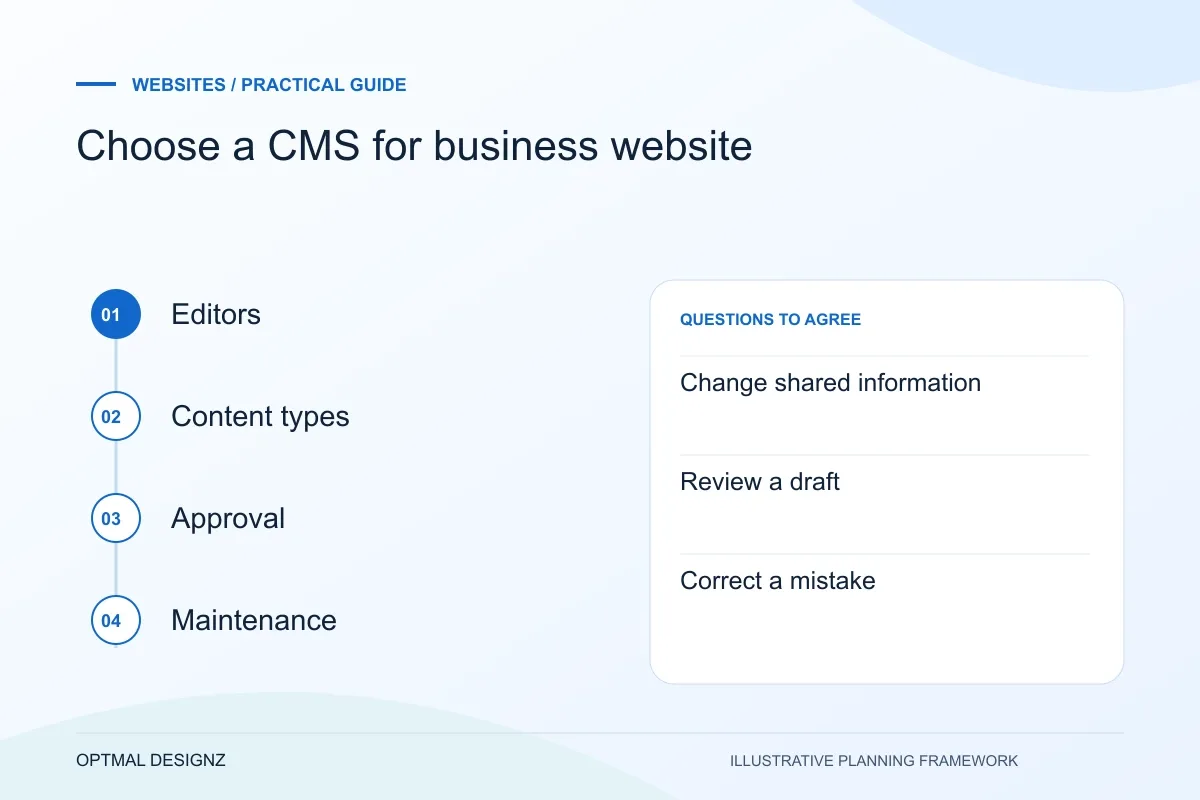
| Editor task | Evidence to collect |
|---|---|
| Change shared information | Where the change appears and how it is previewed |
| Review a draft | Who can approve and publish |
| Correct a mistake | How an editor recovers the intended content |
Worked example: a planning exercise
Hypothetical example: a training provider has one administrator creating courses and a manager approving publication. Its evaluation asks both users to update a course, preview it and publish an approved change. A flexible page builder looks attractive but requires manual duplication of dates across pages. A structured course record may fit better if the team can still handle its genuine exceptions.
Your practical checklist
Use these checks to turn the discussion into decisions that can be assigned, tested and reviewed.
- List editors, reviewers and publishing permissions.
- Demonstrate an actual content update rather than a prepared tour.
- Check reusable content types and unusual page requirements.
- Confirm image preparation, preview and recovery from mistakes.
- Record recurring charges, export access and maintenance ownership.
- Include editor guidance and account handover in the scope.
Apply the checklist to your Oman project
For an Oman brief, make service coverage and delivery or appointment conditions clear for Muscat and other relevant locations. Where commerce is included, test OMR price presentation, required language journeys and the confirmation received by the customer.
Use the example above to discuss choose a cms for business website with the people who will use or approve the result. Ask a supplier to demonstrate the expected output, explain a failure case and identify what is excluded from the proposal.
Related services and next steps
Sources and further reading
Check source guidance directly, especially where platform details or requirements can change.