
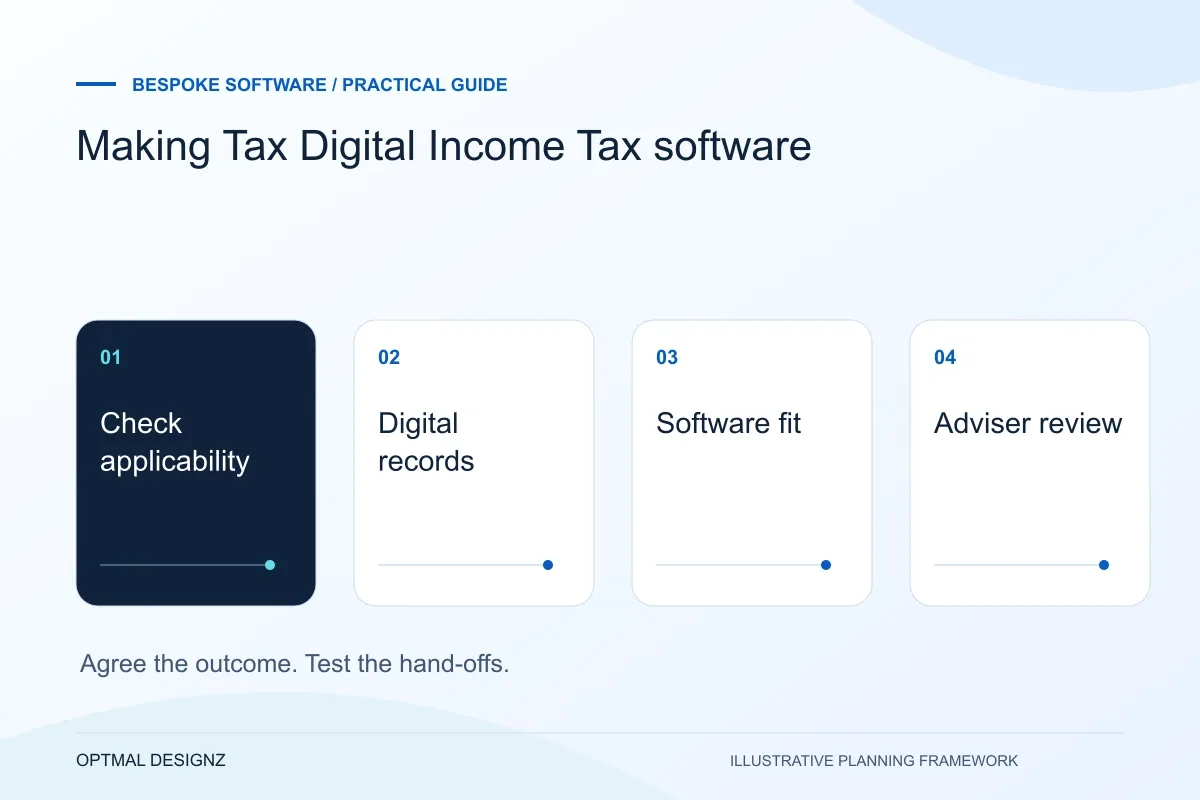
The decision this guide helps you make
Saudi e-invoicing planning starts with the business’s applicable ZATCA requirements, document lifecycle and supported interfaces. A technical project must implement finance-approved rules and test the connection rather than promise compliance through a generic invoice screen.
Define the invoice workflow and the requirements your finance team has verified before agreeing a technical connection. This guide helps you prepare a reviewable scope and acceptance plan.
Review current ZATCA guidance with qualified reviewers, confirm the relevant document types and interface, and test validation, corrections and reconciliation before release.
A practical example to test the choice
An operational application may send approved invoice data to the responsible finance platform while preserving document identifiers and rejected-submission information for review.
This is an illustrative planning scenario, not a claim about a completed client project. Use your own records and operating rules to confirm whether the approach fits.
Establish the applicable requirements with finance
ZATCA describes separate generation and integration phases for Saudi e-invoicing. Its official materials explain invoice requirements and the connection to the FATOORA platform. Review current guidance and any notification relevant to your business with qualified finance advisers; this checklist does not decide applicability, tax treatment or a rollout deadline.
List the legal entities, invoice-producing applications and responsible finance owners. A POS, storefront, ERP and standalone billing tool may each hold part of a transaction. Identify where the authoritative invoice is created and which system records corrections before assessing a new connection.
Define invoice types and the authoritative records
Use finance-approved examples to map customer and supplier identifiers, document references, line items, currencies and corrections. Distinguish the invoice types your business issues rather than assuming one screen or export covers every transaction. Record who approves each field and where source data can be corrected.
ZATCA explains that a scanned or copied paper invoice is not an electronic invoice in the required structured sense. Treat a PDF, printed receipt or QR image as one possible representation of a wider record lifecycle. Establish the required data and supported operations through current official specifications.
- Identify entities, source applications and record owners.
- Approve sample invoice and correction mappings.
- Agree SAR and other currency handling with finance.
- Record validation and reconciliation responsibilities.
Assess the real interface and onboarding route
ZATCA’s educational library includes technical guidance, FATOORA onboarding materials and developer resources. Use those sources when assessing the selected software interface, environment and operational responsibilities. A supplier logo or an unrelated product demonstration is not an acceptance test for your business.
Ask which application prepares the record, how authentication is managed and what response staff see after submission. Agree who owns credentials and environment access, how changes are reviewed and which component may retry a failed attempt. Keep secrets out of ordinary project documents and use authorised test access.
Test failures and corrections as well as a successful transfer
Build the acceptance plan around representative transactions approved by finance. Include missing source information, a repeated request, an unavailable interface and a corrected record. Give every attempt a reference that allows an operator to distinguish a retry from a new business document.
Do not infer completion from a button click or a timeout. Define the statuses the application can actually confirm, who handles unresolved responses and how finance reconciles the source record with the interface outcome. Technical status and statutory interpretation are different review responsibilities.
Hand over an operating process, not only a connection
Document monitoring, reconciliation, authorised corrections, access reviews and the responsibilities of the business and each supplier. Agree how users report an exception and how a technical change is tested before release. Retain an audit trail that lets authorised staff explain what happened to a record.
Review the current official requirements again before the release decision. Optimal Designz does not claim ZATCA endorsement or certification. The project proposal should define the implementation and testing work while qualified reviewers retain responsibility for statutory decisions and the final compliance assessment.
Apply the checklist to your Saudi project
For a Saudi software brief, specify Arabic/English users, business entities and the approved source of each record. Use representative permission and handover cases, with hosting, data handling and any sector-specific obligations reviewed by the responsible people.
Use the example above to discuss zatca e invoicing integration with the people who will use or approve the result. Ask a supplier to demonstrate the expected output, explain a failure case and identify what is excluded from the proposal.
Related services and next steps
Sources and further reading
Check source guidance directly, especially where platform details or requirements can change.