
The decision this guide helps you make
A software handover transfers the information and access needed to operate the agreed system. It should cover accounts, releases, dependencies, data, monitoring, recovery and the person responsible for each ongoing task.
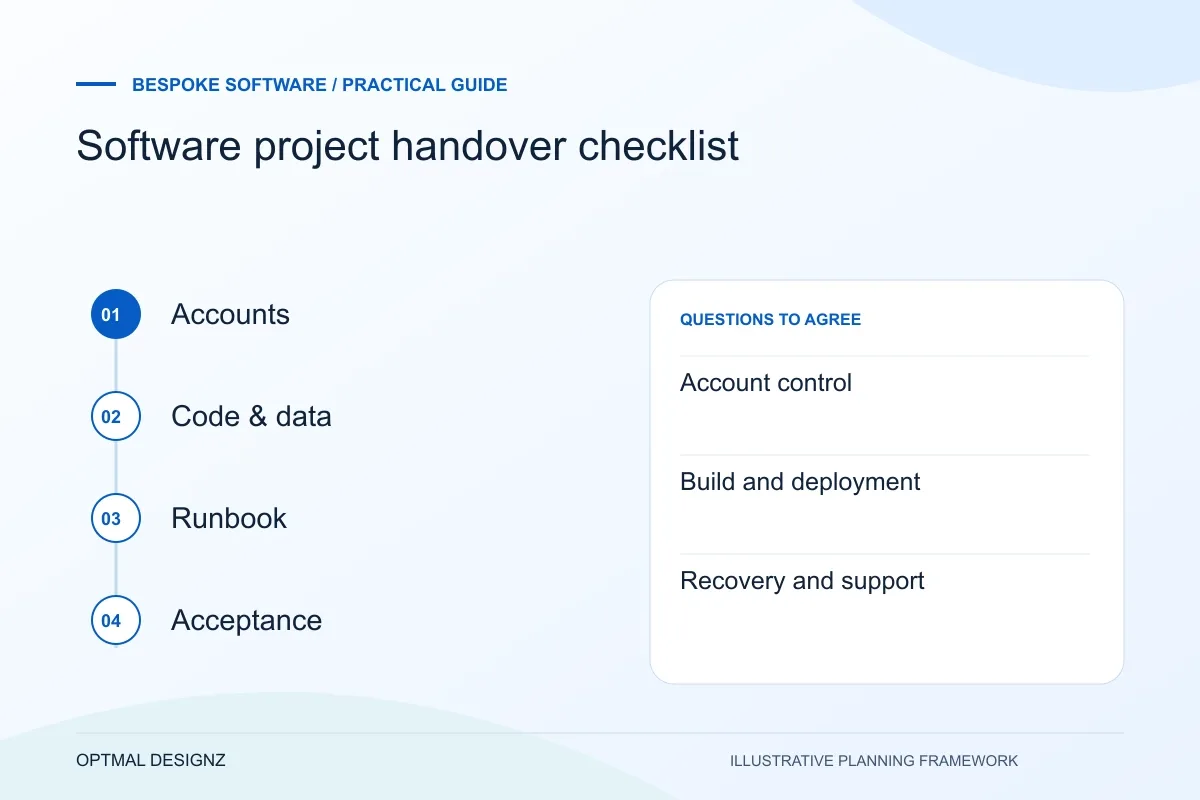
Agree code access, deployment instructions, account control, documentation, data exports and support responsibilities before accepting a software handover.
Check ownership and access directly, follow the release and recovery instructions, and document any retained supplier responsibilities before accepting the handover.
A practical example to test the choice
A working application is difficult to maintain if only a departing supplier controls the hosting account or knows how releases are made. Handover should make those dependencies explicit.
This is an illustrative planning scenario, not a claim about a completed client project. Use your own records and operating rules to confirm whether the approach fits.
Separate ownership from practical control
The contract should explain ownership and licence terms, with appropriate advice where needed. Operationally, the business also needs to know who controls the repository, hosting, domain, database and external-service accounts. A claim that the code belongs to the customer is not a substitute for usable access.
List each account, its business owner and the access another maintainer would require. Transfer or grant permissions through the provider’s supported process. GitHub documents repository transfers and their effects, illustrating why provider-specific details should be checked rather than assuming that emailing a ZIP transfers every setting or dependency.
Turn the Saudi operating model into a practical scope
Follow one task across the people and applications involved. A Riyadh sales office may pass an order to a Dammam warehouse; a service business may need customer approvals before billing. Define which record proves each step is complete and who may change it. Compare configuration and targeted integration before deciding a new application is necessary.
Document legal entities, locations, SAR and other currencies, language fields and role permissions. Review permitted personal-data handling and hosting arrangements with the responsible business owners. Use authorised sample records to test the process before moving to live information.
Ask for instructions that someone else can follow
A handover should identify the application components, build and deployment steps, configuration requirements and the environments in use. Include how to run relevant checks, find operational errors and restore a known version. Record important dependencies and known unresolved issues without putting passwords into ordinary documentation.
Data needs its own plan: exports, backup locations, recovery steps and the people authorised to perform them. GitHub’s backup guidance describes repository content and options, but a code backup does not automatically contain the live database, uploaded files or external-service configuration.
Demonstrate the handover before closing the project
Ask the intended operator or a suitable maintainer to work through a deployment or recovery rehearsal in an appropriate environment. Verify account access, sample exports and issue-reporting routes. Missing instructions are easier to resolve while the delivery team is still actively involved.
Agree what happens after acceptance: incident reporting, coverage, maintenance, change requests and responsibility for supplier updates. Keep the handover record current after later releases. A useful document describes the system people actually operate, not only the version delivered on the first launch day.
Make a handover evidence register
List each required account, document and operational exercise, with the intended recipient and evidence of completion. Distinguish access granted from access actually verified. Include outstanding restrictions and known issues so acceptance does not depend on an implied clean bill of health. A short recorded rehearsal or signed test result can demonstrate that instructions are usable without revealing credentials. Keep the register alongside the project agreement and update it when later changes introduce new services or operational dependencies.
| Handover item | Evidence to request |
|---|---|
| Account control | Intended owner can perform the required action |
| Build and deployment | A suitable maintainer follows the documented process |
| Recovery and support | Test result, escalation route and unresolved issues |
Worked example: a planning exercise
Hypothetical example: a company receives its source repository but the deployment still depends on a contractor’s private service account. A handover review identifies that dependency before acceptance and agrees the supported transfer or replacement process. The rehearsal verifies a deployment using the intended business-controlled accounts.
Your practical checklist
Use these checks to turn the discussion into decisions that can be assigned, tested and reviewed.
- Confirm contractual ownership and third-party licence boundaries.
- Inventory repository, hosting, domain and service-account control.
- Receive build, deployment and recovery instructions.
- Document configuration requirements without exposing secrets.
- Test exports and recovery beyond the source-code backup.
- Agree support coverage, known issues and change ownership.
Apply the checklist to your Saudi project
For a Saudi software brief, specify Arabic/English users, business entities and the approved source of each record. Use representative permission and handover cases, with hosting, data handling and any sector-specific obligations reviewed by the responsible people.
Use the example above to discuss software project handover checklist with the people who will use or approve the result. Ask a supplier to demonstrate the expected output, explain a failure case and identify what is excluded from the proposal.
Related services and next steps
Sources and further reading
Check source guidance directly, especially where platform details or requirements can change.