
The decision this guide helps you make
A Making Tax Digital software project must distinguish the business workflow from the current statutory requirements and the capabilities of the chosen software. Use current HMRC guidance and a qualified adviser to confirm what applies before defining a technical integration.
HMRC is rolling out Making Tax Digital for Income Tax in stages. Check the current rules with HMRC and a tax professional before choosing software or changing a workflow.
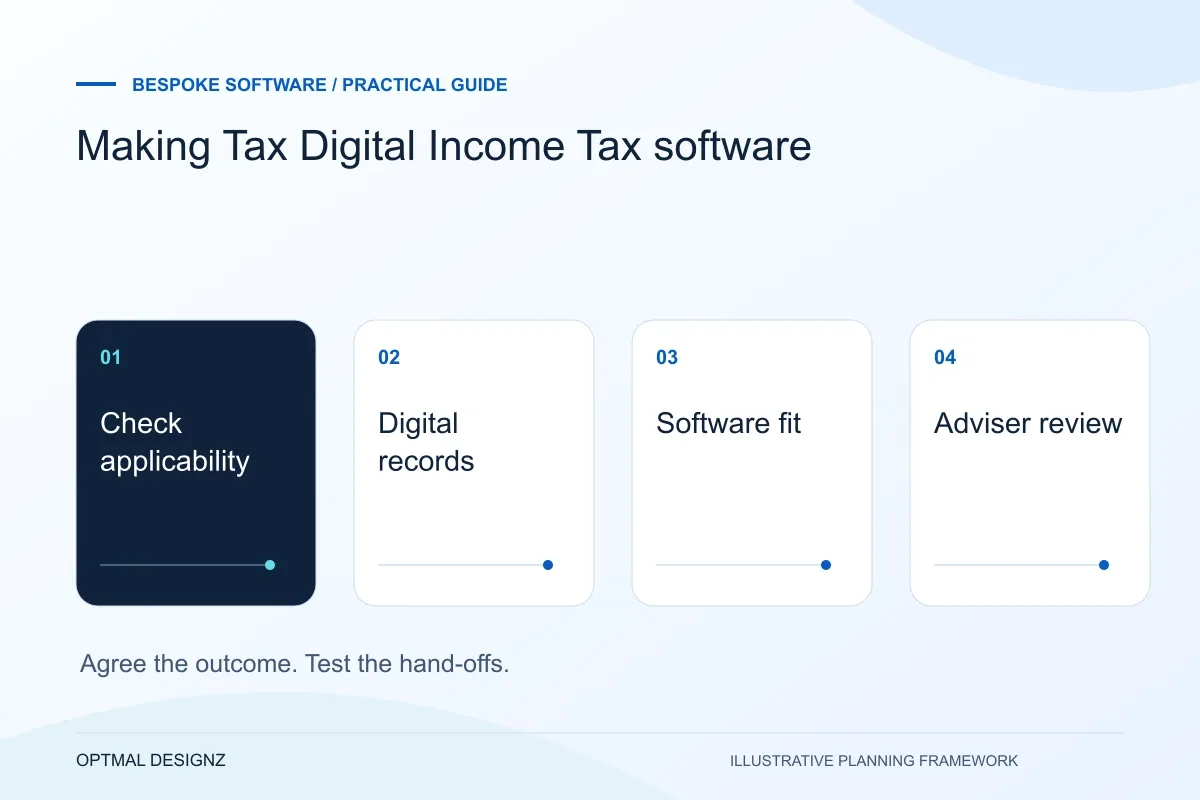
Confirm applicability, the supported software and the responsible adviser, then scope record capture, corrections and reconciliation. Do not infer HMRC recognition from a general development service.
A practical example to test the choice
A business may need clearer records or an accounting connection without commissioning its own filing product. The technical brief should state which existing application performs any supported submission.
This is an illustrative planning scenario, not a claim about a completed client project. Use your own records and operating rules to confirm whether the approach fits.
Check when the rules apply to you
HMRC’s current guidance says sole traders and landlords with qualifying income over £50,000 for the 2024–25 tax year should have started using MTD for Income Tax from 6 April 2026. Those over £30,000 for the 2025–26 tax year are due to start from 6 April 2027, and those over £20,000 for 2026–27 from 6 April 2028. The rules and thresholds are specific; use HMRC’s checker and guidance to confirm your circumstances.
Qualifying income, exemptions, joint property and how income is calculated can affect the outcome. This article is a software planning overview, not tax advice. Confirm the position with HMRC or a qualified adviser before acting.
Understand the records and update workflow
Before selecting software, map how income and expenses are recorded today, where source records are held and who reviews them. Identify business and property income separately where needed, and ask your adviser how your bookkeeping method should support the required digital records and quarterly updates.
Check that the option you choose appears in current HMRC guidance for your relevant use case. HMRC describes software options and the obligation to keep digital records and send updates; a product label or marketing statement alone should not be treated as proof that every required workflow is covered.
- Confirm the start date and qualifying-income calculation
- Check whether an exemption may apply
- Review current HMRC software guidance
- Map records, review steps and quarterly responsibilities
- Plan data migration and access with your adviser
- Keep a record of software and process decisions
Evaluate software for the real work
Compare the record types and reporting your business uses, how bank and accounting data is imported, what review controls are available and how corrections are recorded. If you use spreadsheets or multiple systems, ask whether bridging software or another supported approach fits the current rules and your accountant’s process.
Check access for your adviser, export options, backups, support, subscription terms and what happens if you change provider. Test the workflow before a deadline rather than waiting until the first update is due.
Treat the date as a planning milestone
A practical plan sets aside time to confirm eligibility, choose a suitable option, move or reconcile records, train users and complete a trial update. Responsibility for submissions and the accuracy of records should be clear between the business and any adviser.
Because MTD rules and software capabilities can change, revisit this article against current HMRC guidance before relying on it. The source links below are the authoritative place to check current dates and requirements.
Keep a software decision record with your adviser
Record the relevant income sources, accounting period, required records and the person responsible for each submission step. Use HMRC’s current software finder and confirm that the selected product supports the business’s circumstances. HMRC states that listing follows its recognition process and does not mean it recommends a particular provider. The decision should remain a finance and tax-adviser responsibility, with development work separately scoped.
Apply the checklist to your UK project
Use one actual UK team workflow, including the staff who approve changes and the systems they can access. Distinguish implementation from hosting, licences and ongoing support.
Use the example above to discuss making tax digital income tax software with the people who will use or approve the result. Ask a supplier to demonstrate the expected output, explain a failure case and identify what is excluded from the proposal.
Related services and next steps
Sources and further reading
Check source guidance directly, especially where platform details or requirements can change.