
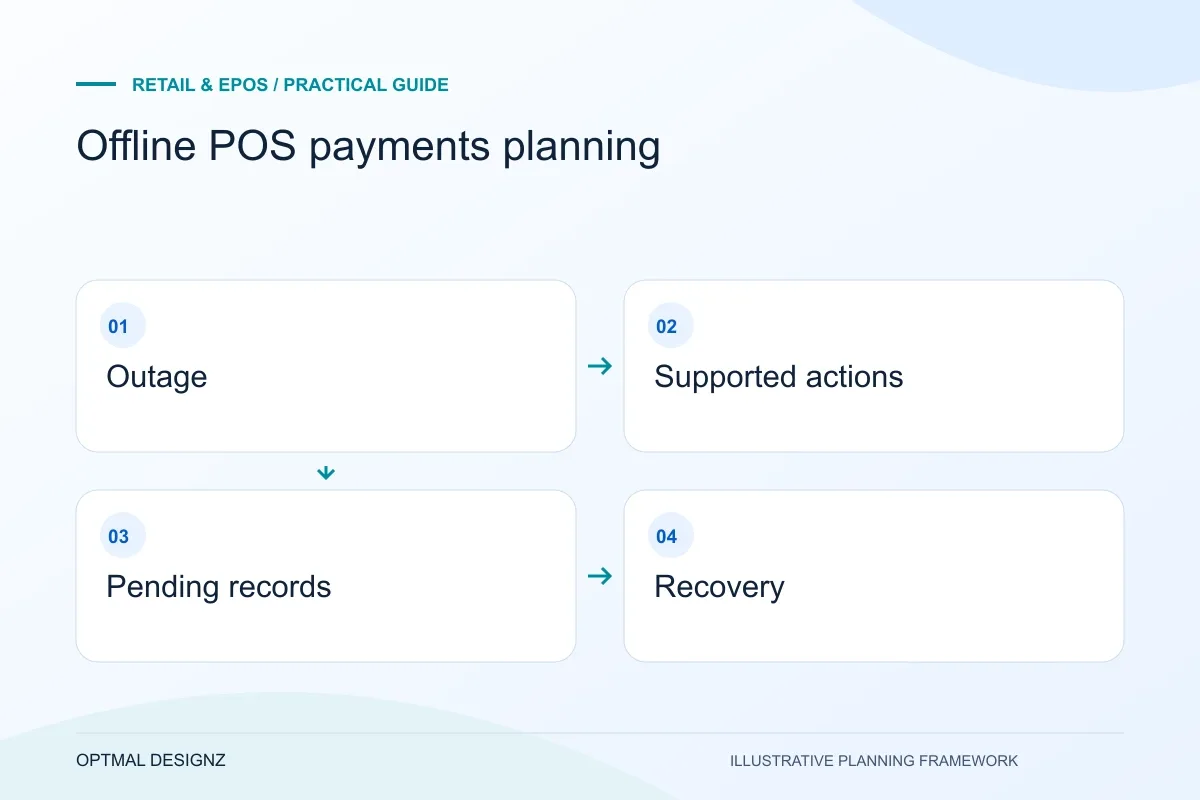
The decision this guide helps you make
Offline POS operation and offline payment acceptance are separate capabilities. A till may record an order while disconnected, but a provider may restrict whether and how it accepts payments, and delayed submission can leave unresolved transactions.
Separate offline order recording from payment acceptance, then verify supported devices, pending transactions, recovery and staff actions with your provider.
Confirm the provider, device and regional capability; define permitted offline tasks, transaction states and reconciliation. Use the current provider documentation, not a general promise of offline working.
A practical example to test the choice
During an outage, staff may be able to create a pending sale while the payment result remains unconfirmed. Retrying blindly can create confusion or a duplicate charge when connectivity returns.
This is an illustrative planning scenario, not a claim about a completed client project. Use your own records and operating rules to confirm whether the approach fits.
Break the word offline into specific capabilities
A system being able to record a sale without a connection does not establish that every payment method, stock update or online order will work. List what staff need during an outage and ask which actions remain available on the exact devices and software configuration in use.
Differentiate loss of local internet from a provider disruption. Staff may see similar symptoms while the supported recovery actions differ. Record the provider’s current advice and a practical escalation route rather than relying on a general claim made during a sales demonstration.
Confirm the handling of pending payments
Square’s UK guidance describes supported offline operations, device-dependent conditions and payment risk. Its separate pending-payment guidance also explains that final status may only become available after reconnection. These are examples of why the actual provider documentation matters; do not apply one product’s rules to another.
Ask about supported methods, limits, upload deadlines and responsibility for later declines or expiry. Check those details in current written guidance for your account and devices. They can change, so this article intentionally does not provide a universal offline-payment time limit or acceptance promise.
Prepare staff and rehearse recovery safely
Create a provider-approved procedure for recognising an outage, identifying permitted actions and tracking unresolved transactions. Include what staff must avoid while records remain pending. Some actions that appear to reset a device can affect data, so recovery steps need to come from the relevant supplier.
After reconnection, review pending items, final payment states, stock and any delayed orders before treating the incident as closed. Test the procedure through an authorised exercise with appropriate controls. An unplanned experiment during live service can create customer and reconciliation problems.
Prepare an outage decision card
Give staff a concise provider-approved record of how to recognise a disruption, which actions are allowed and whom to contact. Include the current source of limits rather than relying on an undated memory of training. Identify the person who checks pending transactions after reconnection and closes the incident. Review the card whenever devices, provider terms or the account setup change. It should make a difficult service situation easier to handle without encouraging staff to experiment with pending payment records.
| Stage | Decision to confirm with the provider |
|---|---|
| Disruption detected | Permitted selling and payment actions |
| Pending transactions | Restrictions, visibility and escalation |
| Reconnection | Final-status review and reconciliation owner |
Worked example: a planning exercise
Hypothetical example: a shop can record a cash sale offline but cannot receive current online orders. Staff follow their agreed procedure rather than promising that all stock information is current. On recovery, an assigned person reviews delayed orders and payment states and reconciles the affected period with the provider’s guidance.
Your practical checklist
Use these checks to turn the discussion into decisions that can be assigned, tested and reviewed.
- List each action needed during an outage separately.
- Confirm exact device, app and payment-method conditions.
- Review current provider limits and responsibility for later failures.
- Give staff approved instructions and an escalation route.
- Avoid resets or account changes unless the supplier directs them.
- Reconcile pending payments, orders and stock after recovery.
Apply the checklist to your UK project
Use the actual UK store, provider account and device models. Follow a sale, return and reconciliation through every affected system rather than relying on a generic till demonstration.
Use the example above to discuss offline pos payments planning with the people who will use or approve the result. Ask a supplier to demonstrate the expected output, explain a failure case and identify what is excluded from the proposal.
Related services and next steps
Sources and further reading
Check source guidance directly, especially where platform details or requirements can change.